
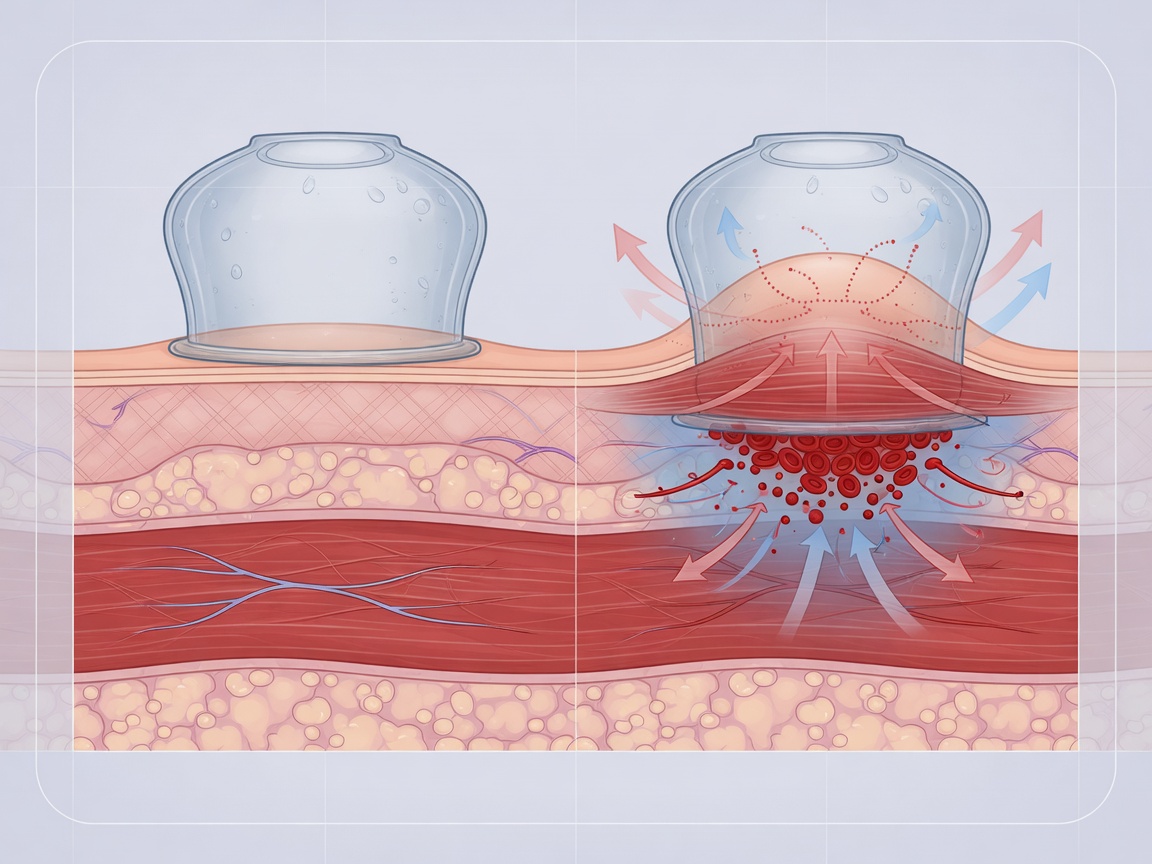
The basic mechanism
A cup is sealed against the skin. Air inside is reduced—by heat (fire cupping), a pump, or by squeezing a flexible silicone cup—creating negative pressure. That pressure draws the skin and superficial tissue upward into the cup.
Unlike massage, which compresses tissue, cupping primarily decompresses it. Many people describe the sensation as a deep pull, stretch, or warm ache rather than a push.
Modern physiological views
Researchers and clinicians propose several overlapping explanations (still an active area of study):
- Local blood flow: Suction can increase circulation in and under the cupped area, bringing warmth and a flushed appearance.
- Tissue and fascia: Lifting may temporarily change pressure relationships in soft tissue and myofascial layers, which some people experience as freer movement.
- Nervous system: Strong sensory input can modulate pain signaling (gate-control style effects) and promote parasympathetic “rest and digest” responses.
- Microtrauma & healing response: Visible marks reflect capillary leakage under the skin; the body clears this as part of normal recovery—not “toxins being pulled out” in a literal detox sense.
Traditional Chinese medicine view
In TCM, health depends on free movement of qi (vital function) and blood through channels. Pain and many chronic symptoms are framed as stagnation or blockage. Cupping is used to invigorate blood, dispel stagnation, and expel external pathogenic factors—especially on the back along major channels.
“Where there is free flow, there is no pain; where there is pain, there is no free flow.” — classical TCM principle often applied to cupping
You don’t have to adopt the full TCM worldview to try cupping—but understanding it helps explain why practitioners place cups where they do.
What the circular marks mean
Marks range from light pink to deep purple-red. They are not impact bruises. Color intensity can relate to suction strength, duration, individual capillary fragility, and local tissue state. They usually fade over 3–7 days (sometimes longer). New or worsening pain, blistering, or signs of infection are not normal—see our safety guide.
Evidence, simply stated
Clinical research on cupping includes trials for low back pain, neck pain, and other musculoskeletal complaints. Some studies report short-term pain relief compared with no treatment or usual care; others show modest or mixed results. Limitations include small samples, difficulty blinding, and variable methods.
How this connects to conditions
When someone has muscular back pain, cupping may reduce local tension and perceived pain for a period of time. When someone has stress-held shoulders, the combination of tissue work and rest can feel restorative. When someone has a red-flag illness, cupping is the wrong tool.
Browse condition guides for symptom-level detail, then compare types of cupping to see which methods match your comfort level.